Why Executives Should Hire a Virtual Assistant in 2026
Delegating is no longer just about the price savings. It's about having time on your hands, working with competent personnel, and developing a system of delegation that works for you.
Your time problem is way more severe than you realize
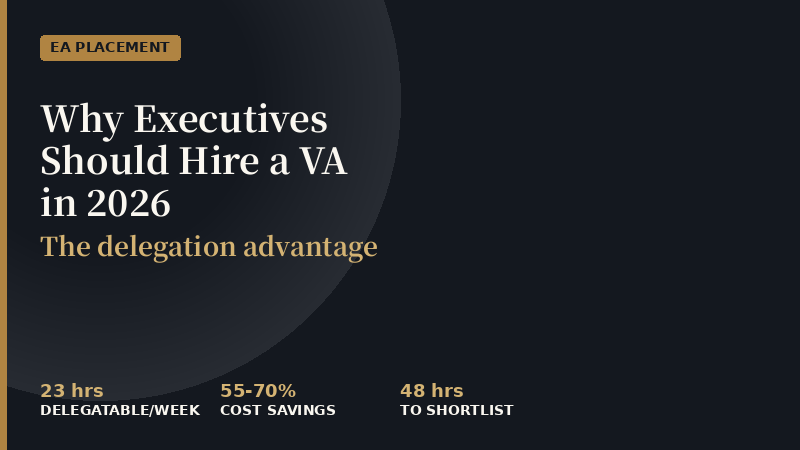
Ask any founder or principal about the issue for just ten minutes, and you'll hear the same old complaint - there aren't enough hours in the day. Your inbox is filling up, and so does the calendar. Travel arrangements, expense reports, preparation for the next meeting, follow-ups. That's about 23 hours worth of work a week that could be done by someone else.
But the actual cost is not just the hours themselves. It's the work that doesn't get done because you're busy with the operational side. The deal that lags behind. The team that waits for the decision. The mounting stress that eventually turns into something much worse.
The executives who work the hardest in 2026 are not the ones pushing through all the hours. These are the ones who know how to delegate properly.
Why 2026 is different
Here are a few changes that make this discussion different from what it was even three years ago.
AI didn't take away assistants' jobs. It made their jobs more important.
When ChatGPT and Claude became available, everyone expected the administration to get automated right away. The truth is more complicated. AI gave rise to a completely new type of work - figuring out how to use it.
There's still a human required to design the workflows. Review the output. Integrate the AI tool to your ecosystem. Decide when something should go to AI and when it has to be done manually.
A competent executive assistant today doesn't compete with AI. They control it. They build Zapier flows to integrate your inbox with your CRM. They utilize Claude for drafting the emails, then add the tone and the context. They analyze data with Perplexity and provide you with a brief you can immediately take action upon.
This is the role that requires much more skill than "calendar manager." And this is precisely the reason why such a trained and tested EA is worth way more than a marketplace VA.
And yes, the timezone math does indeed make sense now. Nairobi is GMT+3. This means that there is a natural 3 to 8 hour overlap with mornings in Europe and late afternoons in East Coast US. Asynchronous workflow is commonplace now. Video updates via Loom, structured exchange via Slack, daily morning briefing document. AI-assisted workflow ensures that context isn't lost overnight.
Executives, who continue demanding "my hours only" are paying two to three times more for the same work done by domestic talent, usually a bit slower, since they manage it themselves.
The talent pool has grown up
Kenya produces over 50,000 university graduates yearly in business, communications, and ICT. Nairobi is the hub of East African professional services. Headquarters of Google, Microsoft, Coca-Cola, and UN Regional offices are all located in Nairobi. This is not "cheap labor". This is educated and English-speaking professionals with extensive multinational corporation experience.
According to EF English Proficiency Index, Kenya is ranked 18th in the world in English proficiency index, which is the highest among East African countries. English is the language of instruction throughout schooling and university. It is the language of business, government, and law.
The true cost breakdown
Let's discuss numbers. The cost of a US-based executive assistant starts from $75,000 to $110,000 a year, including salary, taxes, benefits, vacation, office space, equipment, etc. This translates into somewhere between $6,250 and $9,166 monthly cost.
Vetted and dedicated Kenyan EA through PrimeStart Consultant costs $1,400 to $2,400 a month. 55% to 70% cost saving with comparable or better credentials.
Actually, the cost breakdown comparison misses the mark. The question to be asked is different - how much is your time worth?
For example, at $200 an hour, which is a conservative number for most of our clients, 23 delegatable hours of work cost your company about $4,600 a week. About $239,000 a year. In opportunity cost. An executive assistant costing $2,400 a month, which is $28,800 a year, saves your company almost two weeks' worth of strategic time in the first two weeks of work.
See the full salary comparison and run the ROI calculator.
What to delegate, really?
And if you're curious what you might delegate, here's what our clients delegate in their first 90 days:
Calendar and travel
- Managing the calendar and resolving conflicts
- Booking travel and arranging the itinerary
- Preparing for meetings: preparing agenda, briefs and background work
- Follow-ups and managing the action items
Communication
- Drafting stakeholder emails for you to review
- Internal communication and company-wide announcements
- Communications with clients and maintaining relationships
- Collaboration with vendors and preparing for negotiations
Research and analysis
- Competitive intelligence gathering
- Market research and trends identification
- Due diligence assistance: preparing data rooms and document review
- Writing summaries and taking action items from meetings
Operations
- Updating CRM and managing the sales pipeline
- Handling expenses and processing invoices
- Document creation and formatting: decks, reports, briefs
- Tracking projects and keeping the milestones on the track
AI-powered workflows
- Building Zapier or n8n workflow pipelines
- Setting up AI-driven calendar assistants like Reclaim or Motion
- Developing research workflows with Perplexity and Claude
- Building email triaging systems powered by AI
For a complete list, see our 47 Tasks to Delegate guide.
How to hire a VA and not make all those typical mistakes
Stay away from marketplaces
Marketplaces work great for a simple task to be done once. However, they work very poorly for executive support that you'll need on an ongoing basis. Here's why:
- You do all the hiring yourself. No background checks, skills assessments, reference verifications
- You manage the relationship yourself. There is no success manager, escalation process or guarantee of replacement
- The VA is shared, not dedicated. They work with five or ten different people, you're just one of them
- No continuity. If they get sick or leave you, you lose your inbox and have to start from scratch
Use a managed placement service instead
Managed services take care of things you don't want to:
- Proper vetting process. Our vetting process is five-stages long, including an executive simulation. We accept about 1 candidate out of every 8 we evaluate.
- Matching to your specific needs. We don't rotate through the pool, but find one EA for you
- Success manager. An actual person who manages check-ins and escalation of any issues that arise
- Replacement guarantee. Within five business days, and with a temporary EA in case there are delays.
- NDA-backed. Signing NDAs, using restricted access software and having access audits every quarter
Start with a proper onboarding
No day-one autonomy. A good onboarding experience will include the following steps:
- First week: Tool access, briefing call of 30 minutes, delegation playbook, monitored triaging of your inbox
- Second week: Daily calls of 15 minutes long, independent triaging of your inbox and calendar management, first project
- Third week and beyond: Independence in the execution of tasks, check-ins once per month
Read the full 90-day onboarding playbook for the week-by-week breakdown.
Bottom line
Executives succeeding in 2026 won't be the ones working most hours. They will have the best delegation systems in place.
A vetted, AI-literate, dedicated EA in our managed service costs you approximately half as much as hiring a domestic equivalent. They work your hours. They speak your language. They provide a guaranteed replacement service. The numbers have never been more favorable. The talent has never been more able. The technology has never been better.
The only question is - what will you do with the 23 hours gained?
Want to meet your dedicated EA? Brief us on your position, and in less than two days we will give you a shortlist of 3 candidates. Every single one of them will go through an executive simulation. There are no setup fees. Monthly subscription, cancellation at any time.
Fredrick Gichuki is the founder of PrimeStart Consultant, a Nairobi-based executive support and market research firm serving global principals.
Ready to see what a dedicated EA looks like?
Send us a brief and we'll deliver a shortlist of 3 vetted candidates within 48 hours.
Brief us on your role →